
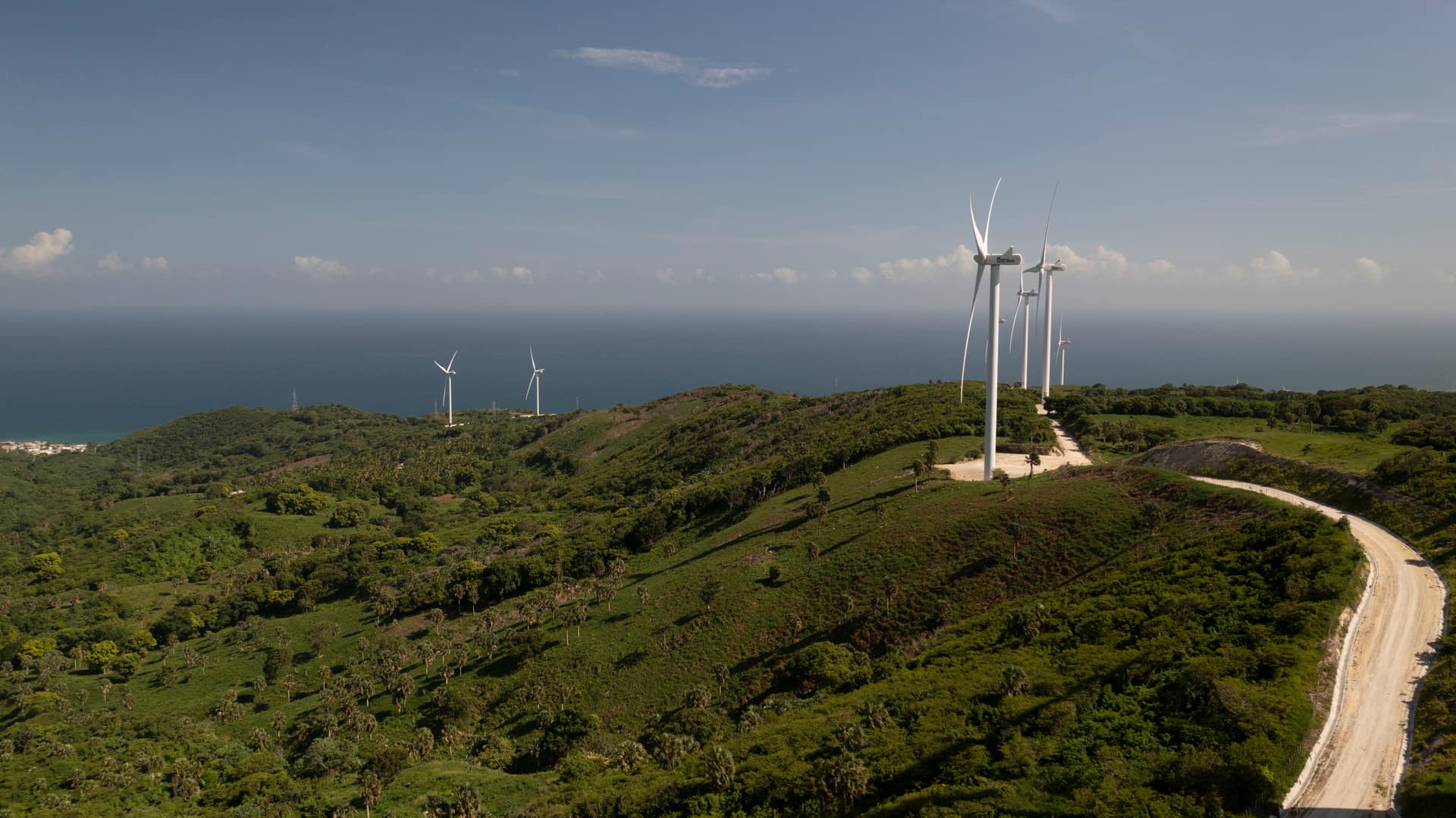
The Dominican Republic leads the transition toward renewable energy in the Caribbean region. With a diversified energy mix, wind farms represent a strategic pillar for national electrical stability. From the imposing wind turbines of Los Cocos and Larimar in the south, through Matafongo in Baní, to the Agua Clara projects in Monte Cristi, keeping these multimillion-dollar assets operationally available is a technical challenge of the highest order. Wind turbine blades, constantly exposed to severe marine conditions, high UV radiation and extreme winds, suffer inevitable structural wear. In this scenario, autonomous drone inspection has established itself as the safest and most cost-efficient standard methodology for predictive maintenance.
Traditionally, inspecting the three blades of a wind turbine required specialized rope-access crews to climb the structures more than 100 meters high, stopping power generation for full 6- to 8-hour shifts per turbine. Today, automated aerial robotics make it possible to scan 100% of the blade surface in just 20 to 25 minutes, completely eliminating human safety risk and minimizing the cost of lost production due to asset downtime.
State of the Wind Energy Sector in the Dominican Republic
The country's wind potential has enabled the development of internationally recognized wind farms, such as:
- Los Cocos and Larimar Wind Farm (Pedernales/Barahona): Operated by EGE Haina, they represent the largest concentration of wind generation in the Caribbean region.
- Matafongo Wind Farm (Baní, Peravia): Strategically located in one of the highest wind-speed zones of the Dominican south coast.
- Agua Clara Wind Farm (Monte Cristi): It harnesses the steady thermal currents of the country's northwest to inject clean energy into the National Interconnected Electrical System (SENI).
Due to their proximity to the Caribbean Sea and the Atlantic Ocean, these farms face an extremely aggressive degradation factor: the combination of tropical humidity, high marine salinity and suspended sand particles. This phenomenon causes accelerated wear on the leading edge of the fiberglass blades, reducing aerodynamics and generation efficiency by up to 12% if not detected and repaired in time.
How Autonomous Drone Inspection Works
The aerial inspection process implemented by Dronematic is a highly technical and standardized workflow divided into three operational phases:
**1. Automated Flight Planning:** No free manual flights are performed. A three-dimensional planning software is used that parameterizes the turbine hub height, the rotor diameter, the blade pitch angle and local wind conditions. The drone performs a programmed autonomous flight that ascends and descends parallel to each face of the three blades consistently, maintaining a millimeter-precise and repeatable safety distance.
**2. Multispectral and Thermographic Data Acquisition:** The drone carries a camera with a super-resolution sensor that captures images at fixed distances to achieve a detail level of millimeters per pixel (GSD < 1 mm). Simultaneously, calibrated high-resolution infrared thermal cameras are used. Thermography reveals internal anomalies impossible to see with the naked eye, such as moisture pockets trapped in the blade core, internal delamination and friction from water ingress into the structure.
**3. Processing and Severity Classification:** The thousands of high-resolution images captured are uploaded to our processing platform, where they are spatially associated with the exact coordinate on the blade (from root to tip, classified across the pressure, suction, leading edge and trailing edge faces).
Most Frequently Detected Types of Anomalies
Our periodic inspections make it possible to preventively identify critical turbine pathologies at early stages:
- Leading Edge Erosion: Degradation of the outer protective layer due to the constant impact of insects, rain and salt particles at extreme speeds.
- Structural Cracks and Fissures: Small mechanical-stress fissures near the blade root or transverse fissures that jeopardize structural integrity in the event of strong gusts.
- Lightning Strike Damage: Caribbean tropical storms often cause atmospheric discharges. We identify burn damage to the lightning receptor system or delamination of the composite material at the blade tips.
- Delamination and Water Ingress: Detachment of the inner fiberglass layers that creates internal voids where moisture accumulates, affecting the dynamic balance of the rotor.
Integration with bladeO-Compatible Formats and Reports
Delivering gigabytes of loose images provides no real value to a wind farm's engineering team. At Dronematic, we process and structure all information under international standards compatible with global blade-management platforms such as **bladeO** and CMMS systems.
Each anomaly identified in our report includes an interactive technical sheet with exact 3D coordinates of its location on the blade, metric dimensions in millimeters (length and width of the crack), categorical classification of the damage type and a severity level indexed from 1 to 5 (where 1 represents minor wear and 5 represents imminent risk of structural failure requiring immediate turbine shutdown). This allows the country's wind farm operators to plan highly efficient blade-repair campaigns justified by auditable data.
Industrial digitalization through drones is not a luxury of the future; it is the most effective tool today to ensure that every Dominican wind turbine keeps spinning at maximum performance with the lowest possible operating cost.


