
A damaged blade does not fail all at once. Leading-edge erosion, delamination and fatigue cracks advance over months before turning into an unplanned shutdown. Inspection frequency is not a maintenance formality: it is what determines whether you catch the problem when it costs to repair or when it costs to replace.
The question every wind farm operator must answer is not whether to inspect, but how often. Under-inspecting lets a cheap problem become an expensive one; over-inspecting burns budget without adding information. Below we explain the recommended frequencies by context, what is detected in each campaign, why automated drone inspection changed the economics of maintenance, and what the operator actually receives at the end of the process.
Recommended inspection frequencies
There is no single interval that fits every farm, but there are well-established baselines worth adjusting to each turbine's environment:
- Annual as a baseline: for most farms, a complete visual blade inspection once a year is the reasonable minimum standard. It lets you track the evolution of any damage from one year to the next and plan repairs in advance.
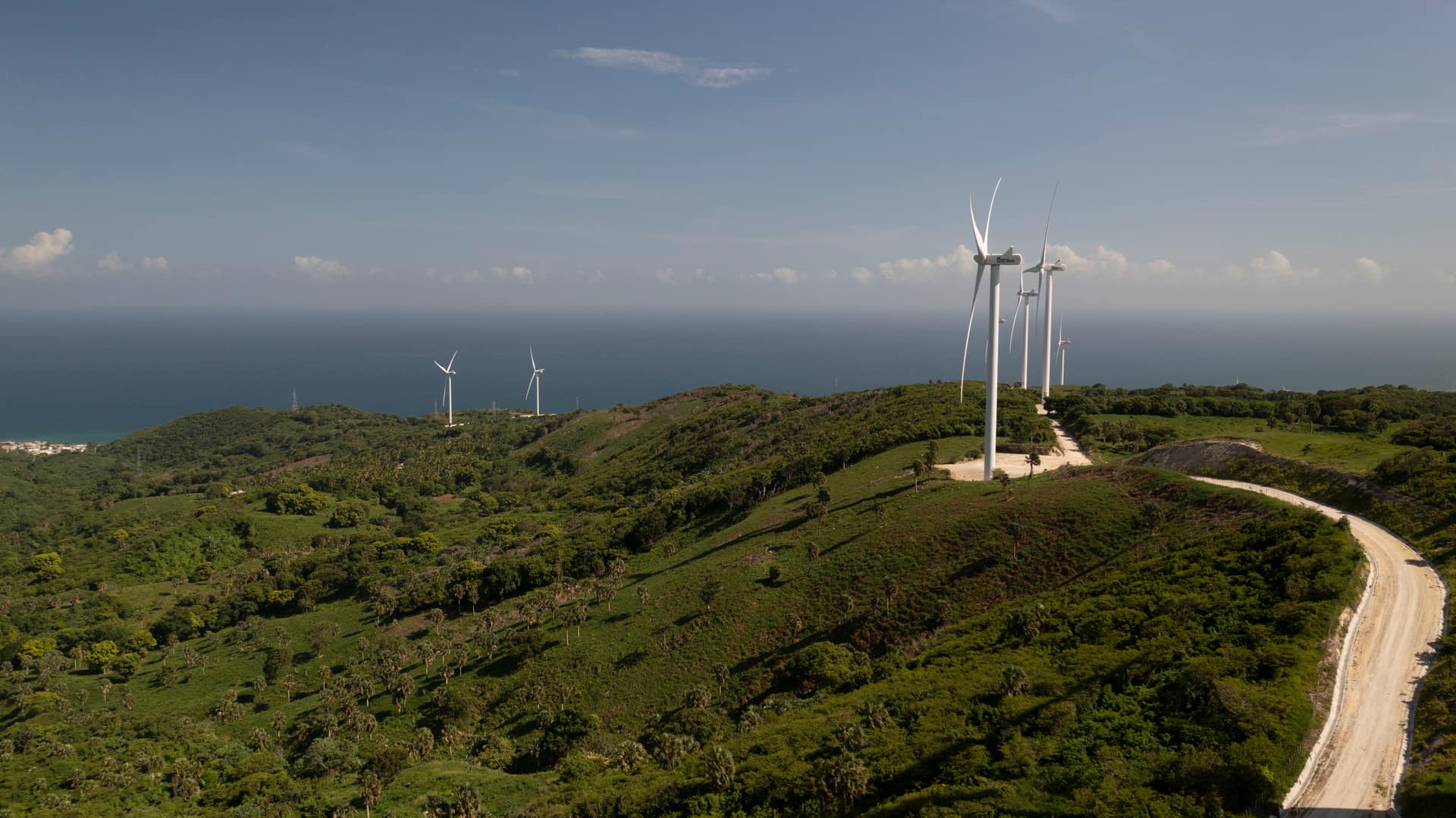
- Semiannual in coastal zones: near the sea, salinity and suspended particles accelerate leading-edge erosion. At coastal farms — very relevant in the Dominican Republic, with wind generation concentrated near the south coast — inspecting every six months keeps you from losing sight of wear that progresses faster than normal.
- Post-event after a hurricane or severe storm: the Caribbean has an annual cyclone season. After a hurricane, a tropical storm or extreme winds, an extraordinary inspection is warranted regardless of the calendar. Lightning strikes, damage from projected objects and out-of-range dynamic loads can leave damage that is only visible up close.
In practice, a good program combines all three logics: a regular cycle (annual or semiannual depending on exposure) plus extraordinary inspections triggered by events. What matters is that the frequency responds to the real degradation pace of your blades, not to a fixed number copied from another farm in another climate.
What a blade inspection detects
A well-executed inspection campaign identifies, at an early stage, the pathologies that, left untreated, end in a machine shutdown:
- Leading-edge erosion: wear of the outer protective layer from the constant impact of rain, salt particles and insects at high speed. It reduces aerodynamics and generation efficiency before it compromises the structure.
- Delamination: separation of the inner composite layers, creating voids where moisture accumulates and altering the rotor's dynamic balance.
- Fatigue cracks: fissures that appear from repeated load cycles, typically near the root or in stress-concentration zones, and that grow over time until they threaten structural integrity.
- Lightning damage: burns and material detachment after an atmospheric discharge, common in the Caribbean storm season.
- Lightning protection system defects: failures in the receptors and in the continuity of the lightning protection system, leaving the blade exposed to greater damage on the next strike.
Why automated drones instead of rope access
A manual drone inspection takes about an hour per turbine. With our automated flight system, that time drops to 20–25 minutes, which lets us cover three times as many turbines in the same day. The difference is not just speed: less time per unit means fewer downtime hours per turbine and the ability to inspect a whole farm in days, not weeks.
Compared with rope-access inspection, the advantage is twofold. Automated flight achieves 100% coverage of the blade surface — all four faces, from root to tip — in a repeatable and comparable way across campaigns, whereas rope access is slow, depends on the technician's skill and exposes personnel more than a hundred meters up. With drones there is no one at height: zero personnel exposed and full blade coverage. That combination of safety and consistency is why automated aerial inspection became the industry standard.
What the operator receives
The value of an inspection is not in the raw images, but in the report that enables a decision. The operator receives severity-classified reports, compatible with blade-management platforms such as bladeO, where each anomaly is located with its exact position on the blade, its dimensions and its damage category. Each severity level implies a different action and timeframe:
- Low severity: minor wear or defect. Action: log and monitor in the next campaign. No immediate intervention required.
- Medium severity: damage that is progressing and worth addressing. Action: schedule repair in a planned maintenance window, without urgency but without postponing indefinitely.
- High severity: damage that compromises performance or integrity in the short term. Action: intervene at the next available shutdown, with priority over minor work.
- Critical severity: imminent risk of structural failure. Action: stop the turbine and repair immediately to avoid a major failure or the loss of the blade.
This grading is what turns an inspection into a management tool: it lets you prioritize repairs with auditable data, justify budgets to management and plan efficient maintenance campaigns instead of reacting to emergencies.
The cost of not inspecting
The real cost of skipping an inspection is not the price of the inspection. It is the difference between scheduled preventive maintenance and an emergency shutdown. A crack detected early is repaired in a planned window, with the turbine out of service for the minimum time and no urgency in the logistics. The same crack detected when it already forces the machine to stop means lost production hours, hiring a crew under pressure and, in the worst case, blade replacement instead of repair. Periodic inspection does not prevent the damage — damage to a blade is inevitable over time. What it prevents is the damage being classified as an emergency.
That, ultimately, is why frequency matters so much. The damage will come; the only variable you control is which category you find it in. At Dronematic we help wind farm operators define the inspection interval appropriate to their coastal and climatic exposure, and we run campaigns with automated flight and severity-classified reports. Tell us how many turbines you operate and where, and we will prepare an inspection plan tailored to your farm.


